Arjo Dedessa Project Fittings Supply: Topsun Custom DI Case Study
 By Mr. Xiao | Pipeline Systems Expert at Topsun | Updated for 2026
The pipeline procurement challenge on an industrial development project in sub-Saharan Africa is categorically different from a municipal water supply tender. A municipal network is built from standard catalog components—DN150 pipes, 45-degree bends, equal tees, isolation valves. The fittings schedule is long, but every item on it exists in a manufacturer's standard production run. A procurement manager with access to a reliable supplier and a reasonable lead time can execute the supply without a single custom engineering decision.
An industrial sugar factory pipeline is not that. The process fluid is not clean water. The pressure profile is not a uniform distribution main. The pipeline routing must navigate around processing equipment, conveyor structures, centrifuge buildings, and cane handling gantries that were themselves being designed and revised concurrently with the pipeline layout. The fittings that connect these process zones are not catalog items. They are engineering problems that require a supplier with design capability, not just a catalogue and a price list.
This case study documents Topsun's supply of custom ductile iron fittings for the Arjo Dedessa Sugar Industry Development Project in the Oromia Region of western Ethiopia—one of the largest integrated sugar industry investments on the African continent at the time of its development. It is written specifically for EPC contractors and procurement directors evaluating whether a ductile iron fittings supplier has the technical capability to execute a custom fittings package on a complex industrial project under real African field conditions and schedule pressure.
Table of Contents
Project Background: The Arjo Dedessa Development and Its Pipeline Demands
Why Standard Catalog Fittings Were Insufficient
Topsun's Custom Fittings Engineering Process
Custom Fittings Supply Scope: What Was Delivered
Challenge: Concurrent Design and Procurement Under Schedule Pressure
Challenge: Industrial Fluid Service and Coating Specification
Challenge: Logistics to a Remote Western Ethiopia Site
Project Outcome and Delivery Performance
What This Means for Your Industrial EPC Evaluation
Frequently Asked Questions (FAQ)
1. Project Background: The Arjo Dedessa Development and Its Pipeline Demands
The Arjo Dedessa Sugar Industry Development Project is located in the Horo Guduru Wollega Zone of the Oromia Regional State, in the Dedessa River valley of western Ethiopia. The project represents a large-scale integrated investment in sugarcane cultivation, processing, and ethanol co-production—a facility designed to contribute significantly to Ethiopia's domestic sugar production capacity and reduce dependency on sugar imports that had historically placed consistent pressure on the country's foreign currency reserves.
For the pipeline supply contractor, the Arjo Dedessa site presented a set of project characteristics that distinguish it fundamentally from either a municipal water supply project or a standard industrial facility in a well-serviced location.
First, the site is remote. The project location in the Dedessa valley is approximately 430 kilometers west of Addis Ababa by road, with the final approach from the main highway involving secondary roads with seasonal surface deterioration. The logistics corridor is entirely road-based—there is no rail access, no river barge option, and no local industrial supply chain for specialty pipeline components. Every fitting that was not on site when it was needed caused a direct construction delay.
Second, the facility design was being finalized concurrently with early construction activities—a common reality on large African agro-industrial projects where project financing, land preparation, and detailed engineering proceed in parallel rather than sequentially. This meant the fittings schedule was a moving target throughout the procurement phase, with fitting dimensions, connection interface standards, and routing configurations being revised as the mechanical design of the processing equipment was progressively confirmed.
Third, the pipeline system serves process fluids across multiple service categories—raw water intake from the Dedessa River, treated process water distribution, irrigation distribution for the sugarcane fields, and wastewater collection from the processing facility. Each service category carries different fluid chemistry, pressure profile, and internal coating requirements. A single generic fittings specification applied across all services would have been either technically inadequate for the aggressive services or over-specified and cost-wasteful for the benign ones.
2. Why Standard Catalog Fittings Were Insufficient
When the initial fittings schedule was issued to Topsun for budgetary review, approximately 65% of the items were standard catalog configurations—double socket bends in four standard angles, equal and reducing tees, concentric reducers, and flanged adaptors in EN 545 compliant dimensions. These items were straightforward to price and source.
The remaining 35% were the problem. They fell into four categories that no standard DI fittings catalog addresses.
Category One — Non-Standard Angle Bends
Several pipeline routes navigating around existing and planned processing structures required direction changes at angles that did not correspond to any of the four standard bend angles (11.25°, 22.5°, 45°, 90°). Specifically, the irrigation distribution main serving the eastern cane field blocks required a series of 30-degree and 67.5-degree bends to follow the field grid geometry without requiring multiple standard bends and intermediate spool pieces that would have added joint count, cost, and hydraulic head loss. Custom angle bends at precisely these angles were required as single-piece fittings.
Category Two — Large Diameter Flanged Tees with Non-Standard Branch Diameters
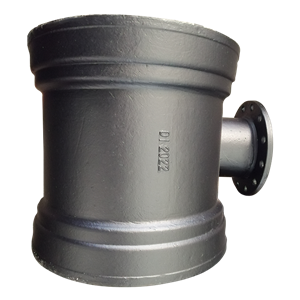
The raw water intake header from the Dedessa River pump station to the treatment facility required a DN600 main run tee with a DN250 flanged branch—a reducing tee configuration that falls outside the standard catalog range for most DI fittings manufacturers, whose standard reducing tee offerings typically cap the branch-to-run diameter ratio at 0.5. The DN250/DN600 ratio of 0.417 is below this threshold and required custom pattern tooling for the casting.
Category Three — Compound Fittings Combining Multiple Functions
At the processing facility's clarifier inlet header, the design required a fitting that combined a 45-degree direction change, a diameter reduction from DN400 to DN300, and an integral puddle flange for the clarifier wall penetration— all in a single casting. Achieving these three geometric functions in separate standard fittings would have required three individual components and two intermediate joints in a location where the clarifier wall thickness allowed only a single penetration fitting. A compound custom casting was the only structurally and geometrically viable solution.
Category Four — Flanged Fittings with Non-Standard Flange Drilling
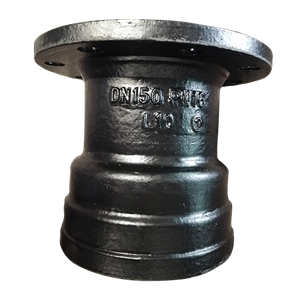
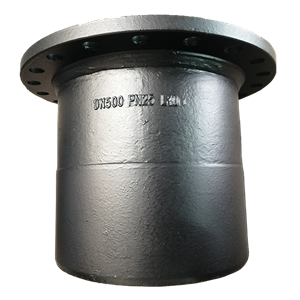
Several items of processing equipment—centrifuges, evaporators, and clarifier mechanisms sourced from European and Asian manufacturers—had pipe connection flanges drilled to standards (JIS B 2220, DIN 2501 legacy dimensions) that did not match the EN 1092-2 standard used throughout the rest of the project's pipeline system. Rather than requiring loose flange adaptors at every equipment connection point—which would have added complexity and potential leak points—the specified fittings at equipment interfaces were custom-drilled to match each equipment manufacturer's specific flange face geometry.
3. Topsun's Custom Fittings Engineering Process
The Topsun custom fittings engineering process for the Arjo Dedessa project followed a four-stage workflow that was designed specifically for projects where the design input is incomplete or evolving at the time of procurement initiation—which, in our experience, describes virtually every large African industrial project.
Stage One — Technical Intake and Clarification
On receipt of the initial fittings schedule, Topsun's technical team produced a detailed clarification register—a structured list of every ambiguous, incomplete, or non-standard fitting description in the schedule, with specific questions for each item. For the Arjo Dedessa project, this register contained 47 clarification items covering non-standard angles, missing flange drilling specifications, unclear connection interface types at equipment connections, and unspecified internal coating requirements for the three different process fluid categories.
The clarification register was issued to the EPC contractor's mechanical engineering team within 72 hours of receiving the initial schedule. This single document—produced before any design or pricing work began—prevented the most common source of rework on custom fittings packages: discovering mid-production that a critical dimension or interface specification was incorrect, requiring the casting to be scrapped and restarted.
Stage Two — 3D Model Development for Non-Standard Items
For all custom and non-standard fittings, Topsun's manufacturing partners produced 3D CAD models of each fitting before pattern tooling was committed. These models were issued to the EPC contractor's mechanical engineering team for review and approval against the pipeline design model. The review cycle for each custom fitting was a maximum of two rounds of revision—any fitting that required a third revision was escalated to a joint technical review session between Topsun's engineering contact and the EPC contractor's lead piping engineer.
For the Arjo Dedessa project, the most technically complex 3D model development task was the compound bend-reducer-puddle flange fitting for the clarifier inlet. This fitting required a three-axis geometric verification to confirm that the puddle flange collar would be correctly positioned within the clarifier wall thickness after the fitting was oriented at its specified 45-degree angle. A two-dimensional drawing could not capture this geometric relationship adequately. The 3D model, issued to the civil team as a STEP file, allowed the clarifier wall penetration sleeve to be positioned with confidence before the concrete was poured.
Stage Three — Pattern Tooling and Trial Casting
For the non-standard angle bends and the large-diameter reducing tee, new pattern tooling was required. Pattern tooling for ductile iron castings is a significant cost item—a custom pattern set for a large-diameter fitting can represent 20–30% of the total production cost for a small quantity order. Topsun managed pattern tooling cost on the Arjo Dedessa project through two mechanisms.
First, non-standard angle bends that shared the same nominal bore and pressure rating as standard catalog items were produced using modified standard core boxes where possible, reducing the extent of new tooling required. The 30-degree and 67.5-degree bends in DN200 used the same straight-bore core box as the standard DN200 bend range, with only the angular deflection pattern plate being custom-produced.
Second, for the DN600×DN250 reducing tee and the compound clarifier fitting, trial castings were produced before the full production run. Each trial casting was dimensionally inspected against the approved 3D model using coordinate measurement, with all critical dimensions verified before the production quantity was released. This trial casting protocol added approximately 8 working days to the production schedule for these items—a delay that was planned for in the project schedule rather than discovered as a surprise.
Stage Four — Pre-Shipment Inspection and Documentation
All custom fittings were subject to third-party pre-shipment inspection by SGS before loading. The inspection scope for custom items exceeded the standard catalog inspection protocol, including dimensional verification against the approved 3D model drawings for every non-standard fitting, coating thickness and holiday testing on all items, and hydrostatic pressure testing of selected large-diameter custom fittings at 1.5 times the rated operating pressure.
4. Custom Fittings Supply Scope: What Was Delivered
| Fitting Category | Description | Diameter Range | Custom Engineering Required |
|---|---|---|---|
| Non-Standard Angle Bends | 30° and 67.5° double socket bends for irrigation field distribution mains | DN150 / DN200 | Custom angle pattern plates; 3D model approval; modified standard core box |
| Large Diameter Reducing Tee | DN600 main × DN250 flanged branch, raw water intake header to treatment facility | DN600 × DN250 | Full custom pattern tooling; trial casting and CMM dimensional inspection; SGS pre-shipment hydrostatic test at 1.5× PFA |
| Compound Bend-Reducer-Puddle Flange Fitting | 45° bend + DN400–DN300 reducer + integral puddle flange, clarifier inlet wall penetration | DN400 inlet / DN300 outlet | Three-axis 3D model with civil team STEP file handover; trial casting with full CMM inspection; puddle collar position verified against wall thickness drawing before production release |
| Custom-Drilled Flanged Adaptors | Flanged spigot fittings at centrifuge, evaporator, and clarifier equipment connections; drilled to JIS B 2220 and DIN 2501 legacy patterns | DN100 / DN150 / DN200 | Bolt circle diameter and hole count verified against each equipment manufacturer's certified flange drawing; custom drill template produced per equipment item |
| Standard Catalog Items | Standard angle bends (11.25°, 22.5°, 45°, 90°), equal and reducing tees, concentric reducers, flanged spigot fittings — all EN 545 / ISO 2531 | DN80 to DN400 | Standard production with internal epoxy or cement mortar lining by service category; zinc + epoxy external coating throughout |
5. Challenge: Concurrent Design and Procurement Under Schedule Pressure
On the Arjo Dedessa project, the design freeze date for the process facility layout was revised three times during the fittings procurement phase. Each revision generated changes to the custom fittings schedule—new items added, existing items revised, and in two cases, custom fittings that had been approved and were in production needed to be stopped and redesigned when a processing equipment layout change shifted the connection point and routing of the pipeline they served.
Managing this concurrent design-procurement environment required a supply chain approach that most standard catalog fittings suppliers are not structured to provide. Topsun's response was a standing change control protocol established at project kick-off, covering three specific scenarios.
Pre-Tooling Changes — Zero Cost, Zero Delay
Changes to custom fitting specifications issued before pattern tooling was committed to production were processed at zero additional cost and zero schedule delay, provided the revised 3D model could be approved within the standard two-round review cycle. The clarification register process—which established the complete specification of every custom item before tooling began—was specifically designed to maximize the proportion of changes that fell into this category.
Post-Tooling, Pre-Casting Changes — Tooling Cost Re-evaluation Only
Changes issued after tooling was committed but before the first casting was poured required a tooling modification cost assessment. In most cases, non-standard angle changes and minor diameter adjustments could be accommodated by modifying the existing pattern rather than producing new tooling from scratch, limiting the additional cost to the modification labor rather than full tooling replacement. Two changes on the Arjo Dedessa project fell into this category—both were resolved within five working days at a cost that represented less than 3% of the affected fitting's total procurement value.
Post-Casting Changes — Full Redesign Protocol
Changes issued after the trial casting was completed required a full redesign and new production cycle. On the Arjo Dedessa project, one item reached this stage—the compound clarifier fitting, where a structural engineering revision to the clarifier wall thickness changed the puddle collar position requirement after the trial casting had passed its dimensional inspection. The original trial casting was scrapped. A revised 3D model was produced, approved in a single review round (expedited at Topsun's request given the critical path status of this item), and a new trial casting was completed and approved. The total elapsed time from change notification to revised casting approval was 19 working days—within the project schedule buffer that had been allocated for exactly this risk.
6. Challenge: Industrial Fluid Service and Coating Specification
The Arjo Dedessa pipeline system served four distinct fluid service categories, each requiring a different internal coating approach. Applying a single generic coating specification across all services—as a less experienced supplier might propose—would have resulted in coating failure in the process fluid services within the first operating season.
| Service Category | Fluid Characteristics | Internal Coating Specified | Technical Basis |
|---|---|---|---|
| Raw Water Intake | River water from Dedessa; moderate turbidity; neutral pH; suspended solids present | Standard cement mortar lining (ISO 4179) | Non-potable raw water at moderate pH — cement mortar provides adequate corrosion protection at lowest cost for this service category |
| Treated Process Water | Softened, low TDS process water for evaporator feed; pH 6.8–7.2; low mineral content | Fusion bonded epoxy (FBE), 250 microns minimum | Low TDS soft water dissolves cement mortar progressively — FBE is chemically inert across pH 4–14 and resists soft water dissolution; no iron leaching risk into process equipment |
| Irrigation Distribution | Treated irrigation water; neutral pH; low pressure (gravity-fed); seasonal use | Cement mortar lining (SRPC, ISO 4179) | Non-potable irrigation service at moderate pH; SRPC cement appropriate for seasonal wet-dry cycling in tropical climate; cost-efficient for the large total length of irrigation distribution fittings |
| Wastewater Collection | Sugar processing effluent; low pH (5.5–6.5); dissolved organic compounds; H₂S potential at collection sumps | High Alumina Cement (HAC) lining (EN 598 specification) | Acid and H₂S resistance required; HAC lining resists acidic organic attack that destroys standard OPC cement lining within months in sugar processing wastewater environments |
The coating specification by service category was developed jointly by Topsun's technical team and the EPC contractor's process engineer during the clarification register phase. This joint development approach was deliberate. The EPC contractor had the process chemistry knowledge. Topsun had the coating technology knowledge. Neither party had sufficient information to make the correct coating selection independently—a fact that is obvious in retrospect but is frequently ignored in procurement processes where the technical specification is issued to the supplier as a fixed document rather than a starting point for engineering dialogue.
7. Challenge: Logistics to a Remote Western Ethiopia Site
The logistics corridor to the Arjo Dedessa site presented a different challenge profile from the Babille Urban Water Supply Project documented in a separate Topsun case study. Where Babille's challenge was the long Djibouti-to-eastern-Ethiopia truck corridor, Arjo Dedessa's challenge was the combination of a longer inland distance from Addis Ababa with a western corridor road quality that was significantly more variable than the main eastern highway.
Custom fittings present a specific logistics risk that standard catalog pipe lengths do not: they are uniquely shaped, often non-stackable, and in the case of large-diameter custom castings, individually heavy enough to require dedicated lifting equipment at every transfer point. A DN600×DN250 reducing tee weighing approximately 280 kilograms cannot be handled with the manual techniques a standard truck crew uses for smaller items. It requires a forklift or crane at the loading dock in China, a ship's crane at Djibouti, a forklift at the transit warehouse, and a dedicated truck-mounted crane for the final site delivery in western Ethiopia—a chain of four lifting events, each of which is an opportunity for handling damage if the lift points and rigging geometry are not communicated to each handler in advance.
Topsun addressed this challenge with two specific protocols for the custom fittings consignment on the Arjo Dedessa project.
Dedicated Timber Crating for All Non-Standard Items
Every custom and non-standard fitting was individually timber-crated before export packing. The crate geometry was designed to the fitting's three-dimensional envelope with internal timber blocking at all contact points to prevent movement within the crate under transport loads. Each crate was marked on all four sides with the fitting reference number, weight, lift point positions (indicated by international lift point symbols), and the orientation requirement (top face marked with directional arrows). This marking system allowed warehouse staff and crane operators at each transfer point to handle the crate correctly without consulting any documentation other than what was printed on the crate itself.
Custom Item Prioritization in Shipping Schedule
Custom fittings were shipped ahead of the standard catalog items in the project supply schedule, despite having a longer production lead time. This counter-intuitive sequencing reflected a simple risk assessment: if a standard DN200 90-degree bend was damaged in transit or failed goods-received inspection, it could be replaced from stock within two weeks by airfreighting a replacement from China. If the DN600×DN250 custom reducing tee was damaged, the replacement production cycle was a minimum of eight weeks from re-order to site delivery. Prioritizing the custom items in the shipping schedule meant the highest-risk, longest-replacement-cycle items were on site first—sitting safely in the project laydown area while the standard items were still in transit.
8. Project Outcome and Delivery Performance
| Performance Metric | Target | Achieved |
|---|---|---|
| Custom Fitting Design Approval Cycle | Maximum two revision rounds per fitting; approval within 10 working days of initial issue | ✅ All custom fittings approved within two revision rounds. Average approval cycle: 8.3 working days from initial issue. |
| Production Schedule Adherence (Custom Items) | All custom fittings on site within contracted delivery window including trial casting cycles | ✅ All custom items delivered within contracted window. One redesign event (clarifier fitting) absorbed within project schedule buffer as planned. |
| Goods Rejection Rate (Custom Items) | Zero rejections at site goods-received inspection for custom fittings | ✅ Zero custom fitting rejections at site. One standard catalog item replaced from buffer stock due to transit damage to socket end. |
| Dimensional Compliance of Custom Fittings | All custom fitting dimensions within ±2mm of approved 3D model critical dimensions | ✅ All critical dimensions within tolerance on final SGS pre-shipment CMM inspection report. |
| Coating Integrity (All Items) | Zero holiday failures on FBE and HAC-lined items; cement mortar lining thickness within ISO 4179 limits | ✅ Zero holiday failures on all FBE-coated custom fittings. All HAC linings passed acid immersion spot test. All cement mortar linings within ISO 4179 thickness limits. |
| Change Control Events Resolved Within Protocol Timeframe | 100% of design change events managed within agreed change control protocol timeframes | ✅ All three change events (two post-tooling, one post-casting) resolved within protocol timeframes. No schedule delay attributable to Topsun change response time. |
9. What This Means for Your Industrial EPC Evaluation
EPC contractors evaluating DI fittings suppliers for African industrial projects in 2026 are operating in a market where the distinction between a catalog distributor and a custom fittings engineering supplier has never been more commercially consequential. The projects being developed across the continent's agro-industrial, mining, and energy sectors are generating fittings requirements that standard catalog supply cannot service. The supplier who cannot produce a trial casting, approve a 3D model, or manage a post-tooling design change is not a viable partner for these projects—regardless of their price list.
The Arjo Dedessa project demonstrates six specific capabilities that define Topsun's position as a custom fittings engineering supplier rather than a catalog distributor.
Pre-production clarification discipline: The 47-item clarification register issued within 72 hours of the initial schedule prevented more rework than any other single action in the project supply chain.
3D model capability for complex geometries: The compound bend-reducer-puddle flange fitting could not have been specified, approved, or verified without 3D model development. Suppliers without this capability would have produced a non-conforming casting on the first attempt.
Trial casting protocol for non-standard items: The trial casting and CMM inspection process added planned lead time but eliminated the risk of a full production quantity of non-conforming custom castings arriving on a remote site with no replacement option.
Service-specific coating expertise: The four-category coating specification developed jointly with the EPC process engineer was technically correct and cost-optimized. A generic "epoxy everywhere" approach would have been over-specified and more expensive for two of the four service categories.
Custom item logistics prioritization: Shipping the longest-replacement-cycle items first is an obvious risk management strategy in retrospect. It requires a supplier who thinks about logistics risk, not just production scheduling.
Pre-agreed change control framework: Managing three design change events during the production phase without a single schedule delay attributable to the supplier's response time requires a framework that is agreed before the first change arrives—not improvised when it does.
Related Case Study: Babille Urban Water Supply Project — Topsun Ductile Iron Pipe Supply Case Study for African Municipal Infrastructure
10. Frequently Asked Questions (FAQ)
Q: What is the minimum order quantity for custom ductile iron fittings that Topsun can produce economically for an African industrial project?
A: There is no fixed minimum order quantity for custom DI fittings, but the economic viability of custom pattern tooling depends on the relationship between tooling cost and the total casting value. As a general guide, for custom fittings requiring new pattern tooling, a minimum of 3–5 pieces of the same fitting type is typically required to amortize tooling cost to an acceptable level. For single-piece custom fittings of high individual value (such as the DN600×DN250 reducing tee on the Arjo Dedessa project), single-piece production is economically justified when the fitting's value and its criticality to the project warrant the full tooling cost. Topsun provides a tooling cost and unit cost breakdown for all custom items before production is committed—procurement directors can make an informed make-or-buy decision before any cost is incurred.
Q: Can Topsun supply custom ductile iron fittings for process fluids other than water — for example, sugar juice, ethanol, or mine process slurry?
A: Yes, with the appropriate internal coating specification for the specific fluid chemistry. Ductile iron is the base material—its corrosion resistance to the specific process fluid is determined entirely by the internal coating selected. For sugar juice and ethanol service, food-grade epoxy coatings (typically fusion bonded epoxy or two-component liquid epoxy to food contact standards) provide adequate protection. For mine process slurry, the coating selection depends on the slurry pH, abrasivity, and temperature—some high-abrasivity slurry services require polyurethane lining rather than epoxy. Topsun's technical team will request the fluid chemistry data sheet and operating conditions before recommending a coating system for any non-standard process fluid service.
Q: What design file formats does Topsun require from the EPC contractor for custom fitting approval, and what formats does Topsun issue for civil and mechanical design team review?
A: For input, Topsun accepts pipeline design drawings in PDF, DWG, and DXF formats for 2D layout reference, and STEP, IGES, or native SolidWorks/AutoCAD Plant 3D files for 3D model input where available. For output, Topsun issues custom fitting 3D models in STEP format (universally compatible with all major 3D design platforms) and 2D dimensional drawings in PDF format as standard. DWG format 2D drawings are available upon request for integration into the project's CAD drawing register. Native format files from the manufacturing partner's CAD system are available for critical complex fittings upon specific request from the EPC's lead piping engineer.
Q: What is the typical production lead time for custom ductile iron fittings requiring new pattern tooling, from approved 3D model to goods ready for shipment?
A: From approved 3D model to goods ready for pre-shipment inspection, the typical production lead time for custom ductile iron fittings requiring new pattern tooling is 35–55 working days, broken down as follows: pattern tooling fabrication (10–15 working days), trial casting and CMM dimensional inspection (8–10 working days), client approval of trial casting report (3–5 working days), production casting run (8–12 working days), coating application and cure (4–8 working days, depending on coating type), and pre-shipment inspection scheduling and execution (3–5 working days). This timeline excludes the 3D model development and approval period, which varies by fitting complexity but typically adds 10–20 working days before tooling can begin. EPC project teams should engage Topsun for custom fittings pre-qualification a minimum of 16 weeks before the required on-site date for complex custom items.
Q: Does Topsun retain the pattern tooling for custom fittings after the initial project supply, and can the same tooling be used for replacement or additional items in future project phases?
A: Yes. Pattern tooling produced for a specific client's custom fitting is retained by Topsun's manufacturing partner for a minimum of five years after the initial production run, at no storage cost to the client. Subsequent orders using the same tooling do not incur a tooling charge—only material, production, coating, and inspection costs apply to re-order quantities. For projects with multiple development phases— such as a sugar factory expansion or a mine infrastructure extension—this tooling retention policy means that custom fittings from Phase 1 can be re-ordered for Phase 2 at standard production lead times (without the tooling fabrication period) and at significantly lower unit cost than the original Phase 1 supply. Confirm tooling retention status and re-order conditions with Topsun's project team at the time of the initial custom fitting order.
The Arjo Dedessa Sugar Industry Development Projectdemonstrates that the ceiling of what a ductile iron fittings supplier can contribute to a complex industrial project goes well beyond catalog supply and logistics coordination. It extends into engineering—into the clarification register that prevents rework, the 3D model that proves a compound fitting will fit a wall penetration before the concrete is poured, the trial casting that confirms a non-standard casting will hold pressure before the production run is committed, and the change control protocol that keeps a supply chain functional when the design is still moving underneath it.
That is the capability standard that African industrial EPC projects require from their pipeline fittings suppliers in 2026. It is the standard Topsun delivered at Arjo Dedessa, and it is the standard we bring to every industrial project engagement.
Need Custom Ductile Iron Fittings for an African Industrial Pipeline Project?
Topsun delivers custom ductile iron fittings with 3D model approval, trial casting protocols, SGS pre-shipment inspection, and service-specific coating selection for industrial projects across Africa. Contact our technical team for a custom fittings engineering capability review.
Request Engineering Capability Statement WhatsApp Mr. XiaoMr. Xiao
Mr. Xiao is a senior pipeline systems expert at Shanghai Topsun Industrial Co., Ltd. He personally managed the custom fittings engineering and supply chain execution for the Arjo Dedessa Sugar Industry Development Project and other African industrial pipeline supply contracts, with particular expertise in custom casting design approval, concurrent design-procurement management, and service-specific coating specification for industrial process fluid applications.
Shanghai Topsun Industrial Co., Ltd. Project Supply Records: Arjo Dedessa Sugar Industry Development Project, Oromia Regional State, Ethiopia.
European Committee for Standardization. EN 545: Ductile iron pipes, fittings, accessories and their joints for water pipelines — Requirements and test methods.
European Committee for Standardization. EN 598: Ductile iron pipes, fittings, accessories and their joints for sewerage applications.
International Organization for Standardization. ISO 2531: Ductile iron pipes, fittings, accessories and their joints for water applications.
International Organization for Standardization. ISO 4179: Ductile iron tubes for water and gas pipelines — Centrifugal cement mortar lining — General requirements.
International Organization for Standardization. ISO 8501-1: Preparation of steel substrates before application of paints and related products — Visual assessment of surface cleanliness.
NACE International. SP0188: Discontinuity (Holiday) Testing of New Protective Coatings on Conductive Substrates.