Fusion Bonded Epoxy DI Fittings: WRAS Compliance Guide 2026
 By Mr. Xiao | Pipeline Systems Expert at Topsun | Updated for 2026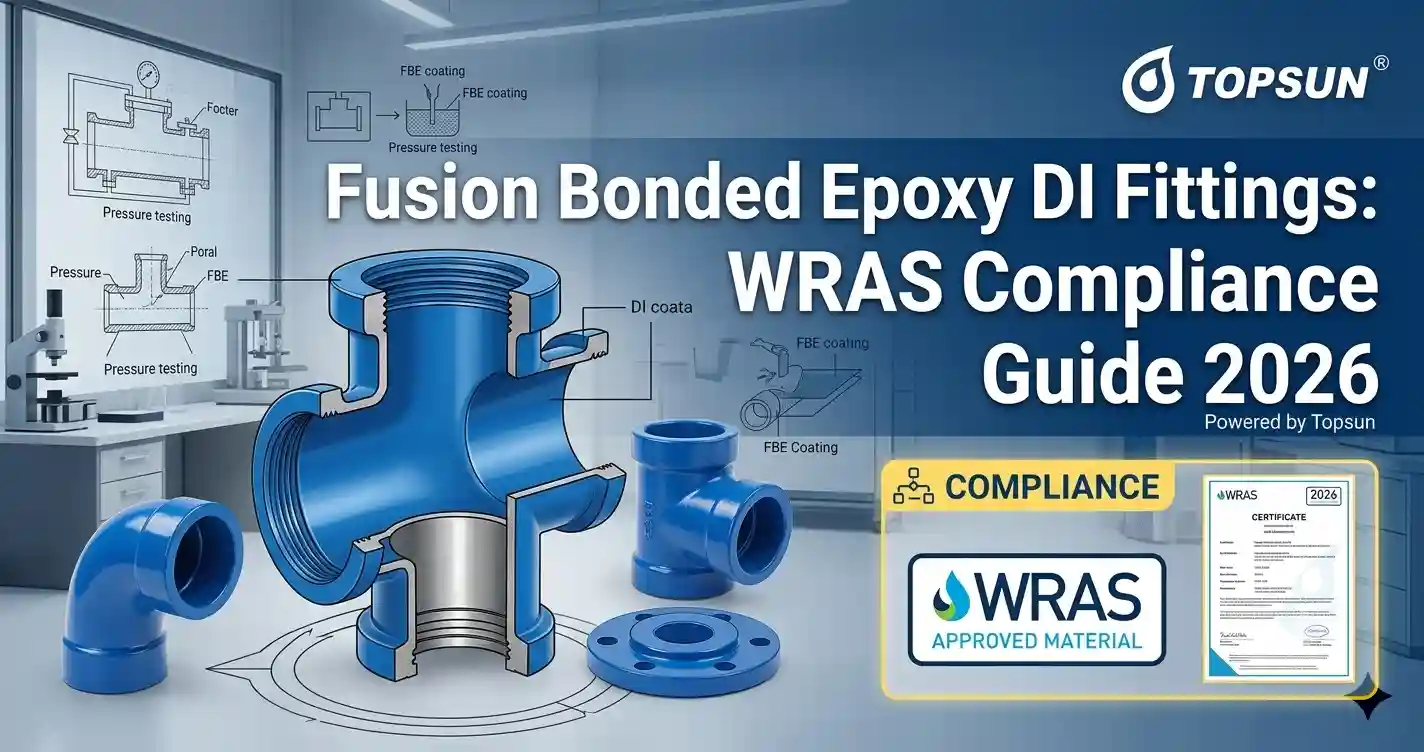
In 2026, the tolerance for anything that could compromise drinking water quality at the point of consumer delivery has essentially reached zero in the European Union, the United Kingdom, and North America. Water quality monitoring engineers and network asset managers are operating under a regulatory environment where a single exceedance of a contaminant threshold—iron migration, organic leaching, turbidity spike—triggers not just a public notification event but a systematic audit of the infrastructure that caused it.
This pressure has fundamentally changed how the best-performing water utilities in these markets specify the internal protective coating of their ductile iron fittings. Cement mortar lining, the long-serving standard, remains technically sound for straight pipe lengths. But at every node in the network—every bend, tee, reducer, and flanged adaptor—the complex internal geometry of a fitting makes uniform, void-free cement mortar application genuinely difficult. The result, in practice, is that cement-lined fittings installed in networks carrying aggressive soft water or low-pH treated water develop localized bare spots that corrode, leach iron, and ultimately compromise the water quality data that monitoring engineers are responsible for defending.
Fusion bonded epoxy DI fittings were developed specifically to solve this problem. This guide explains the chemistry, the approval framework, the performance data, and the specification language that water quality engineers in European and North American utilities need to move confidently from awareness to procurement on FBE-coated ductile iron fittings.
Table of Contents
What Fusion Bonded Epoxy Actually Is—and How It Differs from Liquid Epoxy
Why Fittings Need FBE More Than Pipes Do
The Approval Framework: WRAS, ACS, NSF/ANSI 61, and KTW
FBE Coating Performance Data: What the Numbers Actually Mean
FBE vs. Cement Mortar Lining: A Technical Comparison for Water Quality Engineers
External FBE Coating: Why the Outside Matters as Much as the Inside
Specification Language for Tender Documents
Frequently Asked Questions (FAQ)
1. What Fusion Bonded Epoxy Actually Is—and How It Differs from Liquid Epoxy
The terminology around epoxy coating pipe fittingsis loose in the market, and that looseness creates real specification risks. "Epoxy coated" can refer to at least four distinct coating technologies—fusion bonded epoxy powder, liquid solvent-borne epoxy, liquid water-borne epoxy, and two-component brush-applied epoxy—all of which have radically different performance characteristics in contact with drinking water. For a water quality engineer writing a specification, the phrase "epoxy coated" without further qualification is not a specification at all.
Fusion bonded epoxy (FBE) is a thermosetting powder coating applied to a preheated metallic substrate. The process is precise:
The ductile iron fitting is grit-blasted to a minimum cleanliness of Sa 2.5 (near-white metal) per ISO 8501-1, creating a surface roughness profile of 40–70 microns.
The fitting is then heated to a substrate temperature of approximately 220–240°C in a controlled oven.
Dry epoxy powder is electrostatically sprayed onto the heated fitting surface. The powder particles melt on contact, flow into the surface profile, and immediately begin to cross-link chemically as the heat drives the curing reaction.
The result is a continuous, void-free, chemically bonded film— not a paint layer sitting on top of the iron surface, but a polymer matrix that is mechanically keyed into the surface profile and chemically adhered to the iron oxide layer.
The critical distinction from liquid epoxy is continuity. A liquid epoxy coating applied by brush or spray to a complex fitting internal geometry—especially inside a tee body or a bend—will run, sag, and thin at high points before it cures, leaving film thicknesses below the minimum performance threshold at exactly the most vulnerable locations: internal concave radii and socket entry zones. FBE powder, being electrostatically applied to a pre-heated surface that is already above the powder's melting point, flows and cures uniformly regardless of surface orientation. Internal convex radii, socket bore edges, and flange face recesses all receive the same film thickness as flat external surfaces— typically 250–400 microns in a single application pass.
2. Why Fittings Need FBE More Than Pipes Do
A straight ductile iron pipe length with cement mortar lining is a remarkably well-protected component. The centrifugal application process produces a dense, uniform, well-adhered lining across the full internal bore length, and decades of service data confirm its performance in the vast majority of water chemistries. The case for FBE on straight pipe lengths is real but incremental.
At ductile iron fittings, the case for FBE is categorical. Here is why the geometry of fittings undermines cement mortar lining performance in ways that matter directly to water quality outcomes.
The Internal Geometry Problem
Consider the internal surface of a DN200 reducing tee. The main bore transitions from DN200 to DN150 at the outlet, creating an internal step. The branch bore enters at 90 degrees, creating an internal re-entrant corner at the branch junction. The socket entries at each end have chamfered lead-in edges. None of these features can be reached by a centrifugal application process. Cement mortar applied to a fitting interior is hand-applied or spray-applied—and hand-applied cement in a complex fitting body will inevitably be thinner at internal corners, thicker at accessible flat areas, and absent in deep recesses. These thin and absent areas are exactly where water chemistry attacks first.
The Curing Environment Problem
Cement mortar lining in fittings is cured in ambient conditions rather than in the controlled centrifugal environment of a pipe production line. In warm, dry climates—increasingly common as climate conditions in traditionally mild European and North American regions shift—cement mortar in fittings can dry too quickly before adequate hydration is complete, producing a friable surface layer that sheds particles into the water stream during the first pressurization. FBE has no moisture-dependent curing requirement. It is fully cured within minutes of the fitting exiting the oven, regardless of ambient humidity or temperature.
The Leaching Profile Problem
Freshly cured cement mortar produces an alkalinity spike in the water it contacts for the first several weeks of service—a pH elevation that is well-documented and manageable with a commissioning flush protocol, but which is still a detectable water quality event that monitoring engineers must account for. A fully cured FBE coating produces no measurable leachable alkalinity, no iron migration, and no turbidity release at any stage of service life—which is precisely the compliance profile that WRAS, ACS, and NSF/ANSI 61 approval schemes evaluate and certify.
3. The Approval Framework: WRAS, ACS, NSF/ANSI 61, and KTW
For water quality engineers in European and North American utilities, the approval certification carried by a coating system is as important as its physical performance characteristics. An unapproved coating—regardless of how technically sound it is—cannot legally be used in contact with drinking water in regulated markets. The following is the current approval landscape for FBE coated fittings in 2026.
| Approval Scheme | Jurisdiction | What It Tests | Relevance for FBE Fittings |
|---|---|---|---|
| WRAS (Water Regulations Advisory Scheme) | United Kingdom | Migration of harmful substances into potable water at simulated service conditions (pH, temperature, contact time). Tests both the coating formulation and the applied coating on the actual product. | WRAS listing is mandatory for all materials in contact with drinking water supplied by UK water companies. FBE coatings from approved powder formulators with documented application process control achieve WRAS listing. Always request the WRAS certificate reference number and verify it against the WRAS product approval database before procurement. |
| ACS (Attestation de Conformité Sanitaire) | France | Organoleptic impact (taste and odour), migration of organic compounds, and microbiological growth potential under French Decree 2001-1220 requirements. | ACS certification is required for all pipeline materials used by French water distribution operators. FBE coatings tested under ACS protocols must demonstrate no detectable taste or odour contribution and no promotion of bacterial growth. |
| NSF/ANSI 61 | United States, Canada | Contaminant migration testing against EPA maximum contaminant levels (MCLs). Covers both inorganic (metals) and organic (VOCs, SVOCs) migration from coating into drinking water. | NSF/ANSI 61 certification is required by most North American state and provincial drinking water regulations. FBE coatings for ductile iron fittings must be tested as applied to the actual substrate—an NSF 61 certificate for the powder formulation alone does not certify the applied coating on the fitting. |
| KTW (Kunststoff-Trinkwasser) | Germany, Austria, Switzerland | German Federal Environment Agency (UBA) guidelines for organic materials in contact with drinking water. Evaluates migration, microbiological growth promotion, and organoleptic impact. | German water utilities (Stadtwerke) require KTW or the harmonized DVGW W 270 microbiological growth assessment alongside the material approval. FBE coatings intended for the DACH market should carry both UBA positive list compliance and W 270 assessment documentation. |
| EN 545 / ISO 2531 Coating Annex | Global (standards reference) | Minimum film thickness, adhesion, holiday (pinhole) count, and flexibility requirements for factory-applied internal and external coatings on ductile iron pipe and fittings. | EN 545 Annex A defines FBE as an approved coating type for ductile iron pipe and fittings. Minimum dry film thickness for internal FBE is 250 microns; maximum holiday count is zero in the internal bore section. These are the dimensional compliance criteria that accompany the health-based approval certifications above. |
4. FBE Coating Performance Data: What the Numbers Actually Mean
Approval certifications confirm that an FBE coating does not harm drinking water quality. Performance data confirms that it protects the iron fitting body under the conditions it will actually encounter in service. For water quality monitoring engineers who are also responsible for network asset life, these are the performance parameters that justify the specification.
| Performance Parameter | Test Method | FBE Requirement / Typical Result | Why It Matters |
|---|---|---|---|
| Dry Film Thickness (DFT) | ISO 2808 / SSPC PA 2 (magnetic pull-off gauge) | Minimum 250 microns internal; minimum 250 microns external. Typical production: 300–400 microns. | Film thickness below 250 microns is insufficient to provide a complete diffusion barrier against chloride ion penetration in aggressive water. Below 200 microns, iron leaching begins within 12–18 months in soft water environments. |
| Holiday (Pinhole) Detection | NACE SP0188 / ISO 29601 (high-voltage spark test) | Zero holidays permitted on internal bore surface at test voltage of 5V per micron of specified DFT (i.e., 1,250V for 250 micron specification). | A single undetected pinhole through the coating to bare iron creates an active corrosion cell that will undercut the surrounding coating and grow into a detachment area over months of service, eventually releasing iron particles and coating fragments into the water stream. |
| Adhesion Strength | ISO 4624 (pull-off test) | Minimum adhesion: ≥ 7 MPa pull-off strength. Failure mode should be cohesive within coating, not adhesive at the coating-iron interface. | An adhesion failure at the iron interface—where the coating peels cleanly away from the iron surface—indicates inadequate surface preparation (insufficient grit blast profile) or contaminated substrate. Adhesive failure at <5 MPa is a reject criterion for drinking water service. |
| Cathodic Disbondment | ISO 15711 / CSA Z245.30 | Maximum disbondment radius: 8mm from intentional holiday after 28-day immersion at 65°C in 3% NaCl solution. | Cathodic disbondment measures how far the coating lifts from the substrate when an electrochemical cell forms at a coating defect. Low disbondment means a scratch or installation damage stops growing—critical for buried fittings where post-installation inspection is impossible. |
| Flexibility (Bend Test) | ISO 1519 (mandrel bend test) | No cracking at 1° bend per pipe diameter (for external coating on pipe); no cracking on fitting bodies under hydrostatic test pressures per EN 545. | Ductile iron fittings deflect microscopically under hydrostatic pressure cycles. A brittle coating will micro-crack under this cyclic stress. FBE's glass transition temperature and flexibility characteristics must be matched to the substrate deflection profile. |
5. FBE vs. Cement Mortar Lining: A Technical Comparison for Water Quality Engineers
This comparison is not an argument for replacing cement mortar lining wholesale across a drinking water network. It is a calibrated analysis of where each protective system performs best—and where FBE provides water quality outcomes that cement mortar cannot reliably match in the context of fittings specifically.
| Evaluation Criterion | FBE Coating (Internal) | Cement Mortar Lining (Internal) |
|---|---|---|
| Uniformity on Complex Fitting Geometry | Excellent — electrostatic application reaches all internal surfaces uniformly regardless of orientation | Poor — hand or spray application produces uneven coverage; internal corners and socket entries are consistently thin |
| Initial Leaching Profile | Zero detectable leachables post-cure — no commissioning flush alkalinity peak | Alkalinity (pH elevation) spike for first 2–6 weeks of service — requires extended flush and monitoring protocol |
| Performance in Soft / Low-pH Water | Excellent — FBE is chemically inert across pH 4–14; no dissolution mechanism in aggressive soft water | Limited — cement is dissolved by soft water with pH below 6.5 or TDS below 50 mg/L; progressive thinning and iron exposure result |
| WRAS / ACS / NSF 61 Approval Status | Fully approved under all major drinking water approval schemes when applied from a listed formulation | Approved for most potable water applications; certain cement types (OPC in soft water zones) require verification against WRAS/ACS criteria |
| Hydraulic Smoothness (Manning's n) | ~0.009–0.010 — smoother than cement mortar; lower friction loss through fittings at equivalent flow velocity | ~0.011–0.012 — good, but measurably higher friction coefficient than FBE |
| Self-Healing Capability | None — coating damage requires inspection and repair. Undamaged FBE, however, has no degradation mechanism in normal service conditions. | Passive — micro-cracks are re-passivated by high-pH pore water migrating from intact cement body. Active corrosion cells cannot self-heal. |
| Best-Fit Application | All fittings (bends, tees, reducers, flanged adaptors); soft water networks; high-standard regulatory environments (UK, France, Germany, North America); treatment plant pipework | Straight pipe lengths in neutral-to-alkaline water chemistry; large diameter transmission mains where fitting complexity is limited |
Recommended Product Reference: Topsun Ductile Iron Double Flanged Taper Reducer EN545/EN598/ISO2531 with Epoxy Coating — FBE Internal and External
6. External FBE Coating: Why the Outside Matters as Much as the Inside
Water quality engineers are naturally focused on the internal coating—it is the surface that contacts the water they monitor. But in European and North American water networks, where aging infrastructure replacement is accelerating and fittings are being installed in soils with increasingly variable corrosivity profiles due to changing groundwater chemistry, the external coating of buried ductile iron fittings deserves equal specification attention.
The traditional external coating for buried ductile iron fittings is metallic zinc spray plus bituminous paint—a system that performs adequately in moderate soil conditions and has a 60-year service history. In 2026, two scenarios are pushing utilities toward external FBE specification for critical buried fittings.
Scenario One — Highly Aggressive Soils
Brownfield redevelopment sites, former industrial land, and coastal areas with high chloride groundwater present soil conditions where a standard zinc-bitumen external coating will be consumed within 15–20 years, leaving the iron fitting body directly exposed. External FBE (minimum 300 microns, holiday-free, cathodic disbondment tested) combined with a cathodic protection system provides an external protection level that extends fitting service life to match the 100-year network design life expectation of modern infrastructure asset management programs.
Scenario Two — Above-Ground Treatment Plant Pipework
In water treatment plants across Europe and North America, the shift away from bituminous coated pipework toward FBE-coated and color-coded (blue for potable water, green for raw water, red for fire) external coatings is now effectively the design standard. FBE external coating provides a harder, more impact-resistant surface than bituminous paint, resists UV degradation in exposed installations, and is compatible with topcoat color systems for the color-coding requirement without the adhesion problems that paint-over-bitumen arrangements create.
7. Specification Language for Tender Documents
The following specification clauses are designed to be incorporated directly into a Bill of Materials or product specification document for fusion bonded epoxy DI fittings in European and North American drinking water projects. Each clause closes a specific specification gap that I have observed in commercial tenders reviewed at Topsun over the past several years.
Internal Coating Clause
All ductile iron fittings for potable water service shall have an internal coating of fusion bonded epoxy powder to a minimum dry film thickness of 250 microns, applied by electrostatic spray to a pre-heated fitting substrate at a minimum application temperature of 220°C. Surface preparation shall be to ISO 8501-1 Sa 2.5 minimum with a surface roughness profile of 40–70 microns Rz. The cured coating shall achieve zero holidays when tested to NACE SP0188 at 5V per micron of specified DFT, a minimum pull-off adhesion of 7 MPa per ISO 4624, and shall carry current [WRAS / ACS / NSF/ANSI 61 / KTW — select as applicable] certification for the powder formulation as applied to ductile iron substrate. Certification evidence shall be provided with each production batch test record.
External Coating Clause (Standard Buried Service)
All ductile iron fittings for buried service shall have an external coating of fusion bonded epoxy powder to a minimum dry film thickness of 300 microns, applied concurrently with the internal coating process. Holiday testing shall be conducted per ISO 29601 at a test voltage appropriate for the specified DFT. Cathodic disbondment shall be tested per ISO 15711, with a maximum disbondment radius of 8mm after 28 days at 65°C in 3% NaCl solution.
Documentation Clause
The supplier shall provide for each production batch: FBE powder manufacturer's product data sheet and approval certificates; DFT measurement report (minimum five measurement locations per fitting including internal socket bore and fitting body concave radius); holiday test certificate; adhesion test certificate; and the applicable national drinking water approval certificate with current validity date and reference number.
8. Frequently Asked Questions (FAQ)
Q: Does FBE coating on ductile iron fittings require any special commissioning or flushing protocol before being placed into potable water service?
A: No extended flushing protocol is required specifically for the FBE coating. Unlike cement mortar lining, fully cured FBE produces no measurable alkalinity release or particulate shedding during first fill. The standard network commissioning flush and disinfection protocol (chlorination to 50 mg/L free chlorine per national guidelines, followed by flushing to residual chlorine at distribution level) is sufficient. Water quality engineers should, however, collect and test a first-fill sample from each fitting batch installed in a new network section as part of the baseline sampling program—not because FBE requires it, but because it establishes the pre-service water quality baseline against which any future readings are compared.
Q: Can FBE-coated ductile iron fittings be used in networks carrying disinfected water with chloramine residual rather than free chlorine?
A: Yes. FBE coatings are chemically stable in chloraminated water systems. This is a significant advantage over some elastomeric and cement-based internal coating systems, where chloramine exposure has been associated with accelerated degradation and increased nitrification risk in network dead legs. WRAS and NSF/ANSI 61 approval protocols for FBE coatings test migration at conditions that encompass chloraminated distribution system chemistry. Confirm that the specific FBE powder formulation's approval certificate covers chloraminated water exposure conditions—most current approvals do, but older certifications may need to be reviewed against the utility's current disinfection chemistry.
Q: What happens to FBE coating if a fitting is accidentally dropped during site installation? Is repair possible?
A: FBE is more impact-resistant than liquid epoxy or bituminous coatings but it is not impact-proof. A significant drop impact on a hard surface can create a localized coating disbondment or chip. Any visible coating damage must be repaired with a compatible cold-applied two-component epoxy repair compound approved by the FBE powder manufacturer before the fitting is installed. The repair area must be holiday-tested after cure using a low-voltage wet sponge detector. A fitting installed with unrepaired FBE damage in a drinking water network is a non-conforming installation under WRAS and NSF 61 requirements— the coating integrity certification applies to the undamaged, factory-applied coating, not to a field-damaged fitting with no repair record.
Q: Is there a temperature limit for FBE-coated fittings in drinking water service?
A: For potable water distribution service temperatures (typically 5–25°C in European and North American systems), FBE coatings operate well within their performance envelope with no degradation. The glass transition temperature (Tg) of drinking water FBE formulations is typically 100–120°C, providing a substantial safety margin above any realistic distribution system water temperature. For hot water systems (above 60°C), a specifically formulated high-temperature FBE or an alternative coating system should be evaluated— standard drinking water FBE is not approved for continuous high-temperature service.
Q: How does Topsun document the FBE coating compliance for each production batch of fittings, and what records are available for water utility audits?
A: Topsun provides a full quality documentation package for each production batch of FBE-coated fittings, including: the FBE powder manufacturer's product data sheet and current approval certificates (WRAS, ACS, NSF/ANSI 61 as applicable); the factory application process record confirming substrate temperature, powder batch number, and oven cure time; DFT measurement records with location map; holiday test certificate per batch; adhesion test results; and the mill test certificate for the ductile iron fitting body. This documentation pack is structured to support water utility material approval submissions and regulatory audit requirements directly, without requiring additional reformatting by the procurement team.
The case for fusion bonded epoxy DI fittingsin high-standard drinking water networks is not primarily a cost argument—FBE fittings carry a modest premium over cement-mortar-lined equivalents. The case is a water quality argument: FBE is the only internal coating technology that delivers uniform, pinhole-free, chemically inert protection across the full complex internal geometry of every fitting node in the network, from the day of installation through the end of the network's designed service life. For water quality monitoring engineers who are accountable for the compliance of what flows through every meter of that network, that consistency is not a premium feature. It is the baseline requirement.
Specifying FBE-Coated DI Fittings for a European or North American Drinking Water Project?
Topsun supplies fusion bonded epoxy coated ductile iron fittings with full WRAS, ACS, and NSF/ANSI 61 compliance documentation. Our technical team provides batch-level coating quality records suitable for water utility material approval submissions and regulatory audit support.
Request Compliance Documentation WhatsApp Mr. XiaoMr. Xiao
Mr. Xiao is a senior pipeline systems expert at Shanghai Topsun Industrial Co., Ltd. He has supported water quality compliance submissions and coating specification reviews for drinking water infrastructure projects in the United Kingdom, France, Germany, and North America, with particular expertise in WRAS, ACS, and NSF/ANSI 61 documentation requirements for ductile iron pipe and fittings procurement.
Water Regulations Advisory Scheme (WRAS). WRAS Approval Requirements and Testing Protocols for Materials in Contact with Drinking Water. Oakdale: WRAS, 2023.
NSF International. NSF/ANSI Standard 61: Drinking Water System Components — Health Effects. Ann Arbor: NSF, 2023.
European Committee for Standardization. EN 545: Ductile iron pipes, fittings, accessories and their joints for water pipelines — Requirements and test methods.
International Organization for Standardization. ISO 8501-1: Preparation of steel substrates before application of paints and related products — Visual assessment of surface cleanliness.
NACE International. SP0188: Discontinuity (Holiday) Testing of New Protective Coatings on Conductive Substrates.
International Organization for Standardization. ISO 4624: Paints and varnishes — Pull-off test for adhesion.
International Organization for Standardization. ISO 15711: Paints and varnishes — Determination of resistance to cathodic disbonding of coatings exposed to sea water.
Umweltbundesamt (UBA). Leitlinie zur hygienischen Beurteilung von organischen Materialien im Kontakt mit Trinkwasser (KTW-Leitlinie). Berlin: UBA, 2021.