Ductile Iron Pipe Ultimate Guide: 2026 Specifications & Selection
 By Mr. Xiao | Pipeline Systems Expert at Topsun | Updated for 2026
If you are a water engineer or municipal planner tasked with designing a reliable public water supply network, you already know the stakes. The infrastructure we build today must survive decades of soil shifting, pressure surges, and corrosive environments. In 2026, as urban water demands peak and infrastructure aging becomes a global concern, selecting the right piping material is no longer just a purchasing decision—it is a critical engineering safeguard.
Welcome to the ductile iron pipe ultimate guide. Over my years at Shanghai Topsun Industrial Co., Ltd, overseeing supply chains for projects from the Babille Urban Water Supply to the Dire Dawa public health initiatives, I have seen firsthand what happens when contractors misinterpret pipe specifications. This guide strips away the marketing noise to give you a comprehensive, purely technical breakdown of ductile iron water pipes, their core specifications, and how to source the exact classification for your 2026 municipal projects.
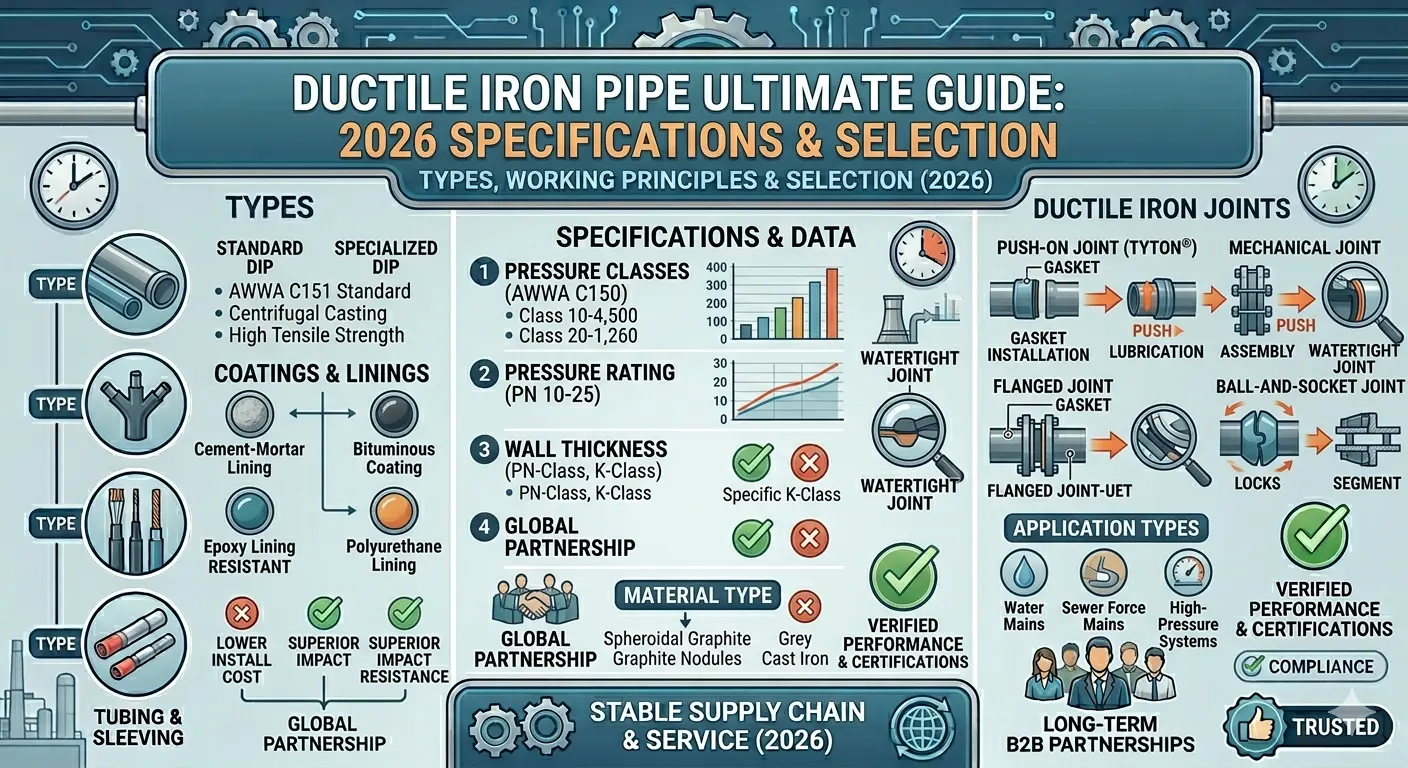
Table of Contents
What Makes Ductile Iron Superior?
Material Comparison in Municipal Engineering
Decoding DI Pipe Specifications (K-Class vs. C-Class)
Essential Internal Linings and External Coatings
Joint Types and Installation Best Practices
Frequently Asked Questions (FAQ)
1. What Makes Ductile Iron Superior?
Before diving into numbers and classes, we need to clarify what makes a ductile iron water pipe mechanically different. Traditional cast iron (grey iron) is brittle because its graphite content forms in flakes. If impacted, those flakes act as stress concentrators, leading to cracks.
Ductile iron (nodular cast iron) is treated with magnesium before casting. This forces the graphite to form into microscopic spheres (nodules) rather than flakes. The result? A pipe that retains the corrosion resistance of cast iron but behaves mechanically like steel—it can bend, absorb impact, and handle tremendous internal hydrostatic pressure without fracturing.
2. Material Comparison in Municipal Engineering
Why do municipal networks still rely heavily on DI pipes in 2026 when plastics and steel are widely available? It comes down to a balance of tensile strength, installation ease, and lifecycle cost. Let's look at the data.
| Feature | Ductile Iron Pipe | Steel Pipe | HDPE / PVC Pipe |
|---|---|---|---|
| Tensile Strength | High (420 MPa min) | Very High | Low to Moderate |
| Corrosion Resistance | Excellent (with standard zinc/bitumen coating) | Poor (requires cathodic protection) | Excellent |
| Installation Difficulty | Moderate (Push-on joints, no welding) | High (Requires on-site welding) | Low |
| Tapping / Branching | Direct tapping is easy and safe | Requires welding pads | Requires special saddles |
For large diameter trunks (DN80 to DN2600), ductile iron remains the most reliable choice because it handles heavy traffic loads (earth pressure) without deforming like plastics, and it doesn't require the expensive cathodic protection networks that steel pipelines demand.
3. Decoding DI Pipe Specifications (K-Class vs. C-Class)
Understanding DI pipe specifications is the most critical part of this guide. Historically, engineers defined pipe thickness using the "K-Class" system (e.g., K7, K9, K12). However, modern ISO 2531 and EN 545 standards have transitioned to the "C-Class" system (Preferred Pressure Class).
The Legacy K-Class System
The K-Class designates the wall thickness of the pipe. A Class K9 pipe has a thicker wall than a Class K7. For decades, the ISO2531/EN545 Class K9 Ductile Iron Pipe for Drinking Water Supply was the absolute standard for municipal grids. You will still see K-class used heavily in tenders across the Middle East, Africa, and parts of Asia.
The Modern C-Class System (C25, C30, C40)
The C-class system classifies pipes by their Allowable Operating Pressure (PFA) in bars. For example, a C40 pipe is guaranteed to operate safely at 40 bar of internal pressure.
C25: Suitable for standard gravity-fed mains or low-pressure municipal distribution.
C30: The standard for most modern pumping mains.
C40: Used in high-pressure transmission networks or areas with severe pressure transients (water hammer).
Recommended Reading: Topsun's ISO2531/EN598 Ductile Iron Pipes DN80-DN2600 Class K9/C25-C40 Guide
4. Essential Internal Linings and External Coatings
A ductile iron pipe is only as good as its protective layers. Bare iron will corrode, so modern pipes are engineered as composite systems. At Topsun, we supply pipes equipped with standard and specialized coatings depending on the fluid being transported and the soil conditions.
Internal Linings
Cement Mortar Lining: The most common lining for a ductile iron water pipe. Centrifugally applied, it creates a high-pH environment at the iron surface, preventing rust. Over time, it also prevents tuberculation (the buildup of minerals that restricts flow).
High Alumina Cement (HAC): Used specifically for EN598 Ductile Iron Sewer Pipes. HAC resists the highly acidic environments caused by hydrogen sulfide gases in sewage.
Polyurethane (PU) Lining: Found in ISO2531 Underground Ductile Iron Pipes with PU Internal Lining. It is incredibly smooth, minimizing friction loss, and is highly resistant to aggressive soft waters.
External Coatings
The standard exterior protection consists of a layer of active metallic zinc (applied via arc spray) followed by a finishing layer of bituminous paint or blue/red epoxy. When the pipe is scratched during transport or backfilling, the zinc creates a galvanic cell, corroding preferentially to protect the iron underneath—a self-healing mechanism that extends the pipe's life to over 100 years.
5. Joint Types and Installation Best Practices
The speed of installing a DI pipeline directly affects project costs. Understanding the joints is essential.
Tyton Joint (T-Type Push-on)
The Tyton Joint (T-Type Push-on) Ductile Iron Pipe is the backbone of municipal water networks. It features a bell (socket) and spigot design with a specific rubber gasket (EPDM for water, NBR for gas/sewage). The spigot is simply pushed into the socket, compressing the gasket to form a watertight seal. It allows for up to 5 degrees of angular deflection, which means the pipeline can follow gentle curves without needing extra bends.
Flanged Joints
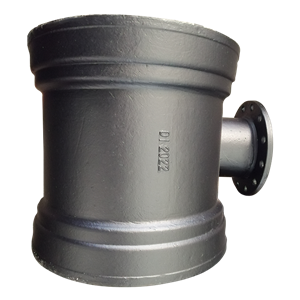
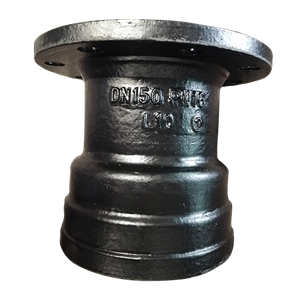
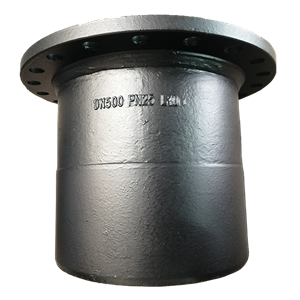
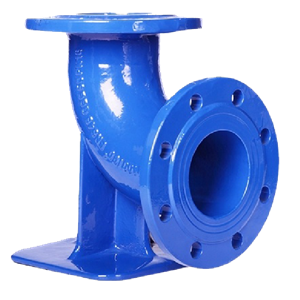
Used primarily in above-ground applications, pump stations, or treatment plants where pipes need to be dismantled for maintenance. Products like the Ductile Iron Double Flanged Taper Reducer or the Ductile Iron Double Flanged Duck Foot Bend utilize bolt-and-nut assemblies to create a rigid, non-deflecting connection.
Restrained Joints
In areas with steep slopes, unstable soil, or high-thrust forces (like near large bends), a Self-Anchored Ductile Iron Pipe with Restrained Joint is used. This joint has an internal locking mechanism that prevents the spigot from pulling out of the socket under pressure, eliminating the need for bulky concrete thrust blocks.
6. Frequently Asked Questions (FAQ)
Q: What is the expected lifespan of a ductile iron water pipe?
A: When properly specified with the correct zinc spray and bituminous/epoxy coating, a ductile iron pipe installed in standard soil conditions has an expected operational lifespan exceeding 100 years. Many early installations from the 1950s are still in active service today.
Q: Can I use EN545 pipes for sewage?
A: No. EN545 is specifically for potable (drinking) water systems. For sewerage and drainage, you must specify EN598 pipes, which feature High Alumina Cement linings or epoxy linings designed to resist the corrosive effects of wastewater.
Q: How do I choose between K9 and C30 classes?
A: It depends on the standard referenced in your project's tender documents. If the project uses older guidelines, K9 refers to a specific wall thickness. If following modern EN545:2010 or newer ISO2531 standards, you should select a C-class based on the maximum operating pressure of your network (e.g., C30 for up to 30 bar).
Selecting the right ductile iron pipes and fittings—whether it is an EN545 Ductile Iron Loose Flange Fitting or a Centrifugal Cast Ductile Iron Pipe Class K9—requires matching the specifications strictly to your terrain, water chemistry, and pressure demands. Topsun remains committed to providing global pipeline system solutions that meet the rigorous demands of 2026 and beyond.
Ready to upgrade your municipal water network?
Contact Topsun today for global pipeline system solutions.
Get a Quote WhatsApp UsMr. Xiao
Mr. Xiao is a senior pipeline systems expert at Shanghai Topsun Industrial Co., Ltd. With over a decade of experience in cross-border trade and municipal engineering projects worldwide, he specializes in ductile iron and pipeline supporting solutions.
International Organization for Standardization. (2026). ISO 2531: Ductile iron pipes, fittings, accessories and their joints for water applications.
European Committee for Standardization. EN 545: Ductile iron pipes, fittings, accessories and their joints for water pipelines.
European Committee for Standardization. EN 598: Ductile iron pipes, fittings, accessories and their joints for sewerage applications.